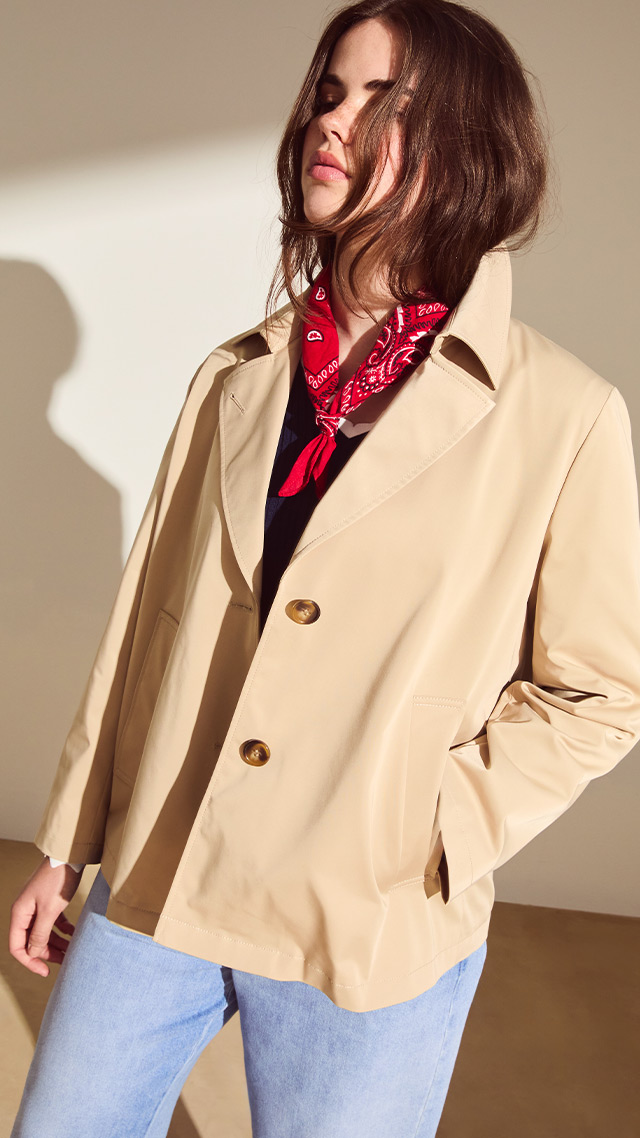
Today, we wear it naturally, almost without thinking about it. It’s one of those pieces that work, that return cyclically without ever seeming out of place. Yet its origins are far from this idea of effortless elegance.
The trench coat was invented in the early 20th century as a functional garment, designed for soldiers in the
trenches: water-repellent, durable and built to face difficult situations. It was protection, structure, necessity. Perhaps it is precisely these deeply practical origins that makes it still so versatile and credible today. In fact, over time, something changes: the trench coat exits from the military context, moves into everyday life and is incrementally reinterpreted.
When it enters the womenswear wardrobe, it does so not as a simple borrowing, but as a conscious choice. It transforms, softens, adapts to new bodies and new intentions. It’s no longer just a garment that protects, but a piece that begins to express. The lines become more fluid, the proportions more relaxed, but its identity remains intact. A unique balance remains: enough structure to define the figure yet enough freedom for
unconstrained movement. It is this harmony that makes it so modern.
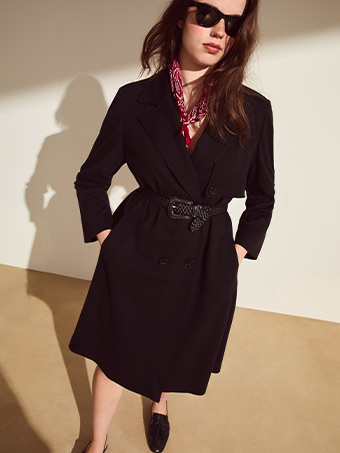
The trench coat has an understated but powerful quality: it follows silhouettes without overwhelming them. It can be worn over a lightweight dress, with denim or with something more structured, and in some way it always manages to hold everything together. Worn open, left to be caught by the wind, it becomes part of the movement, of the way in which we move through space. It’s not just what you wear, but how you live it.
In this sense, it comes close to an idea of elegance that has no need to shout. It doesn’t seek attention, but it holds it. It doesn’t add; rather, it brings order. At a time when fashion often tends towards excess, its presence reminds us that restraint can be a very modern choice.
This is exactly where its value lies. Not so much for what it represents, but for what it allows: freedom of movement, of interpretation, of identity. It is a garment that follows, adapts, and works in real life. And so, every spring, it returns. Not as a trend, but as an evergreen garment, a quiet certainty. Like something we already know, and that, every time, continues to work.



.jpg "Runway FW26")